
Personal and collective transformation are one process, revealed in the alchemical field between us
What is Between-Us?
Between-Us is a way for people to be together that allows intelligence, unity, insight and transformation to emerge between them, rather than staying locked inside separate individuals.
At the heart of the work is something we call the 'field'.
The field is not an idea or a belief system. It is the living relational space that emerges between people when we meet with enough openness, honesty and attention. It is the field that shapes our work and determines where it goes. We don't try to control what happens. Instead we stay attuned to what is emerging, and responsive to it. That gives Between-Us a particular immediacy and vitality. No two groups, and no two meetings, are ever the same.
There is risk in this. We keep approaching thresholds, places where what we already know gives way to something we don't know yet. There can be uncertainty and challenge. We don't know in advance what will happen, and that's part of what makes participation in this work so alive.
What makes Between-Us different?
We are one of many groups around the world exploring new ways of relating. So what sets Between-Us apart?
We don't represent or impose any ideology, belief system or teaching.
We don't stand outside the group as "leaders." We are participants in the process, with a particular responsibility for recognising and responding to what the field is asking of us.
Our aim isn't to make people dependent on us, but increasingly independent of us: able to trust their own experience, their own intelligence, and their capacity to take part fully in the collective.
We bring decades of spiritual practice and realisation to this work, while deliberately stepping away from the hierarchies, authority structures and "teacherism" that have shaped so much of the spiritual and self-development world.
And we're not building a centralised organisation around ourselves. We're part of a growing worldwide community of connected, independent groups, each discovering what becomes possible when people learn to work this way.
What does Between-Us ask of us?
It asks something of us.
Authentic participation.
Vulnerability, and a willingness to risk.
A willingness to set our familiar stories and identities aside, at least for a while, and discover what's here without them.
And a focus on integration rather than transcendence: letting what's discovered in the field become part of everyday life, rather than using extraordinary experience to escape from it.
This isn't always easy. It can challenge some of our deepest assumptions about who we are, how we relate to one another and what we believe.
What Between-Us isn't
It isn't a technique, method or formula.
It isn't mysticism.
It isn't guru dependence.
It isn't a call to conformity or groupthink
And it isn't group therapy or self-improvement
It is an exploration of what becomes possible when people learn to meet each other in a way that lets something larger than any one individual emerge.
And because we don't know in advance where this exploration will take us, the work stays radically open: alive to what is emerging, responsive to what the moment asks, and willing to go beyond what we already know.
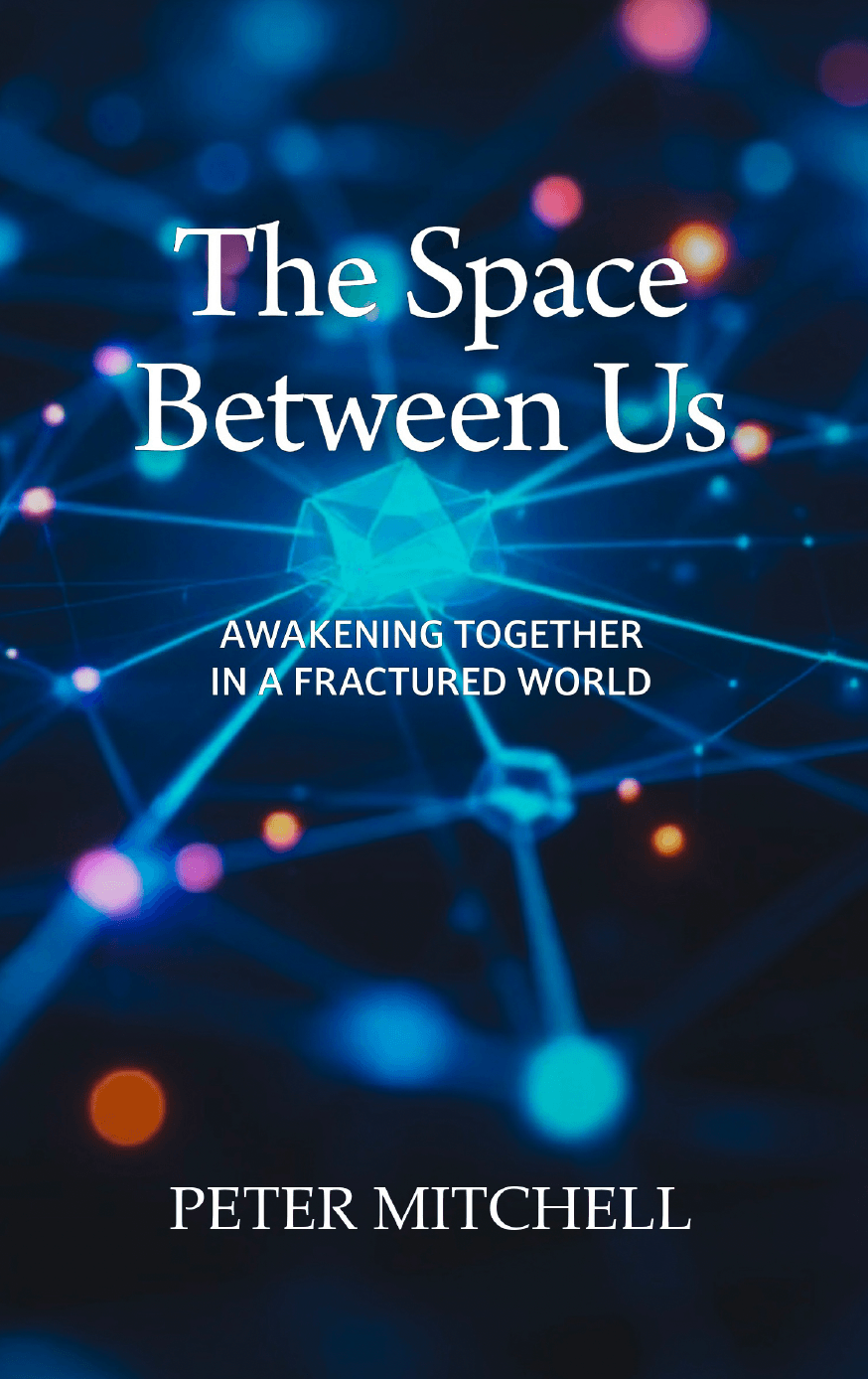
The Space Between Us
Awakening together in a fractured world
Sometimes the implications of a discovery demand to be shared.
That is how this book came to be written.
Anne and I are founder members of a small experimental group whose unfolding over several years revealed the extraordinary potential for transformation — both individual and collective — when people meet with openness and authenticity.
Recognising that similar explorations were also emerging elsewhere, I felt a growing impulse to share our discoveries.
The Space Between Us grew from that imperative. Today, the exploration continues through the Between-Us Groups we are beginning to seed around the world.
Peter Mitchell, author
The larger implications of this work
The Between-Us work draws on a largely untapped human capacity: the capacity for something new to emerge between us when we meet in the right conditions.
This capacity has appeared at different times and in different places throughout human history, in Quaker meetings, Indigenous councils, Bohmian Dialogue circles and other forms of collective inquiry. Yet although there are glimpses of what becomes possible, we have barely begun to explore or understand its full potential.
The crises we face today are increasingly beyond the capacity of individuals to solve, however intelligent, well-intentioned or capable they may be. They require more than better individual answers. They require new ways of thinking and being together, ways in which we can access forms of intelligence, creativity and understanding that are not available to any one of us alone.
Something fundamental changes when we begin to recognise that intelligence, creativity and understanding do not belong exclusively to separate individuals, but can emerge between us, deepen through our interaction, and become something greater than the sum of our individual capacities. We are no longer simply trying to become better individuals and then apply our individual capacities to the problems we face. We begin to discover another source of intelligence altogether.
There is something deeply significant here for the individual too. Your life is no longer experienced as something that is only about you and your own development, fulfilment or search for meaning. You begin to discover yourself as part of something larger: part of a living human whole, with a contribution that is uniquely yours to make. The movement is from the individual to a larger context, without losing the uniqueness or autonomy of the individual.
If this capacity can be developed and consciously cultivated, its implications extend far beyond individual relationships. It could change how we understand leadership, learning, creativity, decision-making and collaboration; how groups and organisations function; how communities respond to complexity; and how we approach problems that no individual or institution can adequately comprehend alone.
There are already groups and organisations around the world exploring this territory, and a growing interest in what becomes possible when we begin to take the collective seriously. The Between-Us work is part of this wider movement, while bringing its own particular understanding of what can happen when we learn to meet each other differently.
Beyond all of this lies a larger possibility: that humanity itself may be capable of developing new forms of collective intelligence and new ways of organising our shared life. Not through imposing a new ideology or system from above, but through discovering, from the ground up, what becomes possible when human beings learn to think, perceive and create together in a fundamentally different way.
We do not yet know where this could lead. But that is precisely why this territory matters. We are beginning to explore a human capacity whose implications may extend far beyond the transformation of individuals or the creation of more effective groups.
The deeper question is what might become possible for humanity when we discover that the intelligence available to us is not limited to what any one of us can know, but includes what can emerge between us.
Perhaps one of the great challenges of our time is not simply to discover who we are, but to discover who we can become together.
Discover the future of awakening as a relational and collective phenomenon and how that can change human life.
To be kept informed about Between-Us Groups,
and notified when new groups start
please sign up
© 2026 Between-Us Groups™. All Rights Reserved | Website Terms of Use | Privacy Policy